| Brand Name: | HeJin |
| Model Number: | HJ076 |
| MOQ: | 1 Set |
| Price: | Negotiatable |
| Payment Terms: | L/C,T/T |
| Supply Ability: | 1 set per 3 months |
Protecting Battery Cell Integrity Starts at the Filling Port
A battery cell can pass a visual inspection and still have a sealing issue that is difficult to identify from the outside. For lithium-ion battery manufacturers, the electrolyte filling port deserves special attention because its closure must meet the sealing requirements defined for the finished cell.
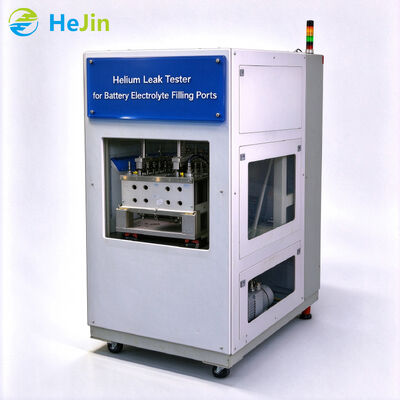
HeJin's battery filling port leak inspection solution is developed for manufacturers seeking a more controlled approach to evaluating critical sealing interfaces. Designed around helium leak detection technology, the system supports inspection of designated filling-port areas under defined test conditions.
As an equipment developer and manufacturer, HeJin works with customers to evaluate the battery structure, testing requirements, fixture design, and production environment before determining the appropriate equipment configuration.
From a Small Sealing Interface to a Measurable Quality Requirement
The challenge in battery leak testing is not simply finding a leak. It is establishing a repeatable inspection process that can distinguish acceptable workpieces from those that do not meet the required sealing criteria.
Three manufacturing considerations are particularly important.
Sealing Quality at the Electrolyte Filling Port
The filling-port closure may involve a plug, welded joint, sealing element, or another structure depending on the battery design. Defects at the designated interface can create potential leakage paths that require appropriate testing to identify.
A dedicated filling-port inspection arrangement helps focus the test on the intended sealing boundary instead of relying solely on general visual checks.
Consistency Between Production Batches
Variations in joining quality, component positioning, closure assembly, or sealing conditions may influence the final result. A controlled leak-testing procedure provides a consistent basis for checking the specified acceptance criteria across production batches.
Reliable Decisions Before the Next Manufacturing Stage
A clearly defined acceptance threshold helps production and quality teams determine whether a tested workpiece meets the agreed requirement. When a leak is detected, further investigation can help identify the underlying manufacturing issue.
The objective is to make sealing inspection a measurable part of quality control rather than an assumption based on appearance.
Application Scope: Which Areas Can Be Evaluated?
The primary application is the designated electrolyte filling-port sealing interface of a compatible lithium-ion battery cell.
Depending on the workpiece construction and confirmed test arrangement, the inspection scope may include:
Not every battery design uses the same filling-port structure. Inspection coverage must be established from the workpiece drawing and verified using the selected fixture and detection method.
| Item | Parameter |
|---|---|
| Tracer Gas | 10%–99.9% Helium |
| Helium Recovery | No |
| Helium Pressurization | 0–0.25 MPa (adjustable) |
| Detection Precision Variance | < ±30% |
| Power Supply | 380 V, 3-phase, 5-wire, 50 Hz |
| Power Consumption | 6 kW |
| Helium Inlet Pressure | 0.5 MPa |
| Helium Purity | ≥99% |
| Nitrogen Inlet Pressure | 0.2 MPa |
| Nitrogen Purity | 99.9% |
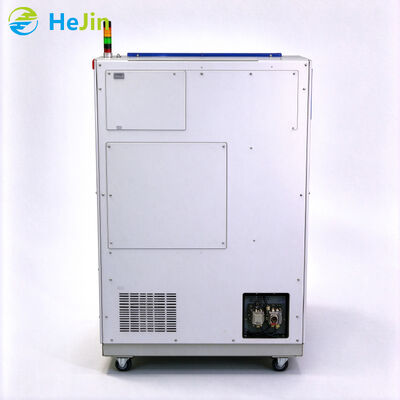
| Equipment Dimensions | 1300 (L) × 1000 (W) × 2000 (H) mm |
| Noise Level | < 65 dB |
Why Work Directly with HeJin?
Engineering and Manufacturing Under One Roof
HeJin combines equipment development, engineering design, and manufacturing capabilities. Direct communication with the manufacturer helps customers clarify the technical scope before equipment specifications are finalized.
Designed Around the Application
Battery filling-port geometry, test sensitivity, and production requirements can vary between projects. HeJin can evaluate customer drawings and testing objectives to discuss suitable fixtures and system configurations.
Clear Technical Communication
A successful project depends on agreement about the workpiece, detection method, acceptance threshold, operating sequence, and delivery scope. Direct technical discussions help establish these requirements before production begins.
Support Beyond the Purchase
Equipment delivery is only one stage of a manufacturing project. Commissioning arrangements, operator guidance, maintenance documentation, spare parts, and troubleshooting support should be defined according to the customer's needs and the agreed service scope.
Practical View of Equipment Value
The right testing solution should support the manufacturer's quality objectives while fitting the production environment. Fixture durability, testing consistency, maintenance requirements, and production integration all contribute to long-term value.
FAQs
Is this equipment intended for battery electrolyte filling ports?
Yes. Its stated application is leak testing around the designated electrolyte filling-port sealing interface of compatible lithium-ion battery cells. The exact inspection coverage depends on the confirmed configuration.
Why use helium rather than visual inspection alone?
Visual inspection can identify visible defects but cannot independently establish the absence of a small leakage path. Helium tracer-gas detection provides a measurement-based approach when the required sensitivity and test conditions are properly defined.
Can the equipment meet a specific leak-rate requirement?
The required leak-rate threshold must be specified by the customer and verified against the actual equipment configuration. Detection capability should be validated under agreed test conditions before acceptance.
Can HeJin develop fixtures for a particular battery design?
HeJin can evaluate application-specific fixture requirements using workpiece drawings, representative samples, and the intended test procedure. The final design depends on the actual battery structure and project scope.
What should be included in the technical quotation?
The quotation should clarify the workpiece, inspection area, detection method, leak-rate threshold, cycle time, fixture design, automation functions, data requirements, and after-sales arrangements.
Discuss Your Battery Leak Testing Requirements with HeJin
The most effective inspection solution starts with a clear understanding of the battery design and the quality requirement that must be verified.
Share your filling-port drawing, target leak-rate threshold, expected production capacity, and preferred testing arrangement with HeJin. Our engineering team can review the application and discuss the equipment configuration required for your manufacturing process.
HeJin — Engineering and Manufacturing Solutions for Industrial Leak Testing.
Overall Rating
Rating Snapshot
The following is the distribution of all ratingsAll Reviews