| Brand Name: | HeJin |
| Model Number: | HC9914C1 |
| MOQ: | 1 Set |
| Price: | Negotiatable |
| Payment Terms: | L/C,T/T |
| Supply Ability: | 1 set per 3 month |
Two numbers decide whether a socket outlet survives its first export inspection: the force it takes to insert and withdraw a standard plug, and how many normal operation cycles it completes before the contacts or the shutter give up. IEC 60884-1 puts both in the same family of clauses, and both are measured by a machine with a force sensor, a servo driven plug holder and a counter that cannot be reset by accident.
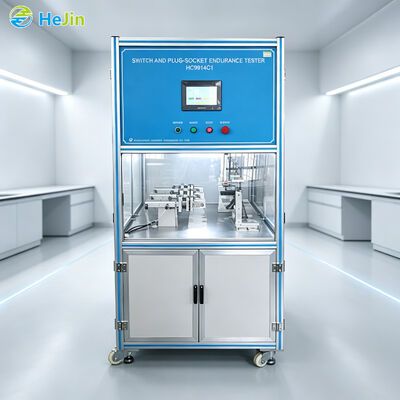
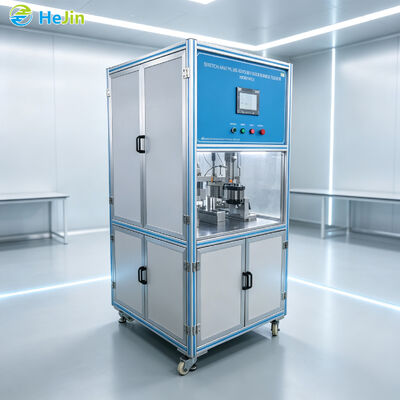
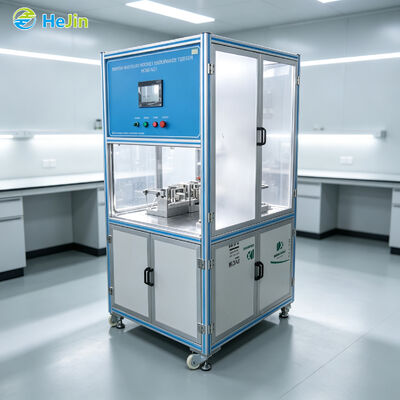
This two station bench runs the mechanical clauses of IEC 60884-1 in one setup: insertion and withdrawal force measurement on one station, endurance cycling on the other. In practice that means one operator, one fixture set, and one report with both numbers on it.
| Standards | IEC 60884-1 clause 20, 21 and 22, GB 2099.1, VDE 0620, BS 1363 (fixture dependent) |
| Force range | 0 to 200 N, resolution 0.1 N, accuracy ±1% of reading |
| Force sensor | Strain gauge load cell, factory calibration certificate, third party calibration available |
| Stroke | 0 to 100 mm programmable, insertion depth set by recipe |
| Speed | Insertion and withdrawal 5 to 75 mm/s, constant speed motion profile |
| Cycle rate | Programmable, up to 30 cycles per minute |
| Counter | 0 to 999999 cycles, 6 digit, power failure memory |
| Stations | 2 independent stations on one frame, each with own drive and fixture |
| Drive | Servo motor with ball screw on each station, force and position feedback |
| Fixtures | Interchangeable plug holders and socket mounts, custom fixture available |
| Data | Force curve per cycle, CSV export over USB, run summary on screen |
| Controller | PLC with 10 inch touch screen, 40 recipes, operator login |
| Power supply | AC 220 V 50/60 Hz, 1.2 kW (110 V available) |
| Footprint | Approx. 1500 x 800 x 1400 mm, weight 260 kg |
Force is measured at the plug, not inferred from the motor. A load cell sits in the plug holder path, so the reading is the actual force on the plug pins. Motor current based estimates drift with temperature and lubrication and will not survive a review.
Servo driven, constant velocity. Insertion speed affects peak force, which is why the standard fixes it. A pneumatic cylinder accelerates and overshoots, giving a peak that is 10 to 20% high. The servo profile here holds constant speed through the whole stroke and logs the position where the peak occurs, which is usually the shutter cam, not the contacts.
Two stations, one report. Station one runs the force sequence on a fresh sample while station two is cycling an endurance sample. Both stations write into one data file, so the endurance curve and the force check are matched to the same batch without manual bookkeeping.
Calibration you can prove. The load cell ships with a factory calibration sheet traceable to a national standard, and the fixture geometry is recorded so a reviewer can check the moment arm. Third party calibration through SGS or a CNAS accredited lab can be quoted with the machine.
| Comparison item | HongCe two station bench | Pneumatic entry level rigs | European lab benches |
| Force measurement | Load cell in plug path, ±1% | Spring gauge or none | Load cell, comparable |
| Motion profile | Servo, constant velocity, position logged | Pneumatic, overshoot at end of stroke | Servo, comparable |
| Stations | 2 independent, simultaneous force and endurance | 1 station | Often 1 station, 2 as option |
| Data output | CSV per cycle with force curve, no licence fee | Counter only | Software licence, often extra |
| Fixtures | Standard set plus custom fixture from your drawing | Universal clamp, poor repeatability | Standard set, custom costly |
| Budget level | Mid range, roughly half of European list | Lowest | Highest |
Q: Can it test different national plug types?
Yes. The plug holder and socket mount are interchangeable parts. Schuko, British, French, American and Australian fixtures are available, and custom fixtures are made from your sample.
Q: Does the standard require 5000 or 10000 cycles?
It depends on the product and the clause. Socket outlets usually require 5000 cycles for normal operation, with higher counts for special designs. The counter is programmed freely, so you follow the clause you are testing.
Q: Is the force gauge calibrated before shipment?
Yes, with a factory certificate. Many labs also order a third party certificate, which we can arrange at cost and which adds about five days.
Q: Can I run the endurance test with the socket energised?
Yes. The load can be connected through the fixture with a resistive or inductive load bank as an option, so temperature rise during cycling can be monitored.
Q: What about a socket with a very stiff shutter?
Force range goes to 200 N, far above the limits in the standard, so stiff or faulty samples are measured rather than jamming the machine.
Q: Delivery time?
30 to 60 days for the three station configuration, 20 days for a single station version.
About Guangzhou Hejin Automation
Guangzhou Hejin Automation Control Technology Co., Ltd. has been manufacturing testing equipment for plugs, sockets, and switches since 2015. Our product range, which complies with the IEC 60884-1 standard, includes gauges, force testers, lifespan (durability) test benches, temperature-rise test apparatus, and cord anchorage test devices. These instruments are currently used by socket manufacturers and laboratories in over 30 countries worldwide.
If you are compiling a comprehensive list of IEC 60884-1 clauses, please feel free to share it with us. Before providing a formal quotation, we will clarify which clauses can be tested using our standard equipment, which require specific fixtures, and which may necessitate custom development.