logo

products details

Created with Pixso. Home Created with Pixso. Products Created with Pixso.
Environmental Test Chamber
Created with Pixso.

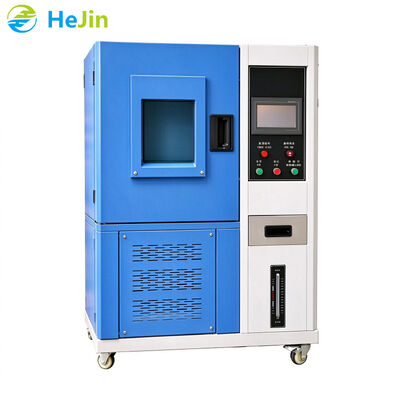
100 L Capacity High and Low Temperature Test Chamber with -70°C Low Temperature and IEC 60068 Compliant Environmental Test Chamber

100 L Capacity High and Low Temperature Test Chamber with -70°C Low Temperature and IEC 60068 Compliant Environmental Test Chamber

Brand Name: HeJin
Model Number: HJ-EMTC-031-2
MOQ: 1 Set
Price: Negotiatable
Payment Terms: L/C,T/T
Supply Ability: 10 set per 3 months
Detail Information
Place of Origin:
China
Certification:
Third party calibration certificate/ CE(cost additional)
External Dimensions:
1000 × 900 × 1725 Mm
Working Dimensions:
500 × 400 × 500 Mm
Nominal Capacity:
100 L
Low Temperature:
Up To -70°C
High Temperature:
+100°C / +150°C
Power Supply:
AC 220 V, 50/60 Hz
Humidity Control:
Configurable
Temperature Change Rate:
Programmable Profile
Packaging Details:
Plywood
Highlight:

100 L Capacity High and Low Temperature Test Chamber

,

-70°C Low Temperature Environmental Test Chamber

,

IEC 60068 Compliant Thermal Cycling Test Chamber

Product Description
High and Low Temperature Test Chamber for Industrial Product Validation

While a product might pass inspection at room temperature, its performance could shift after prolonged exposure to high or low-temperature environments. High and low-temperature test chambers enable engineering teams to study and analyze these changes under controlled, repeatable conditions.

HeJin specializes in the R&D and manufacturing of various industrial environmental test equipment. By communicating directly with the manufacturer to receive expert engineering support—and leveraging a wide range of configurable test chamber options—clients can thoroughly discuss details such as sample dimensions, temperature requirements, and testing procedures before selecting the ideal system.


Evaluate Performance Beyond Room Temperature

Temperature exposure can affect materials, assemblies, and components in different ways. Plastics may change dimensions, rubber compounds may become less flexible, and electronic assemblies may show changes in operating behavior. The outcome depends on the material, construction, exposure duration, and test conditions.

An environmental chamber provides a controlled space in which these effects can be investigated systematically. Engineers can establish a baseline, expose samples to a defined temperature, and compare their condition or performance before and after testing.


Testing Capabilities

Low-Temperature Testing

Low-temperature exposure can help evaluate material flexibility, dimensional stability, component functionality, and performance following cold storage or transportation.

Typical test subjects include rubber seals, plastic housings, connectors, sensors, and selected automotive components.

High-Temperature Testing

High-temperature exposure helps assess material aging, deformation, appearance changes, and functional behavior under specified thermal conditions.

Applications may include polymer components, electronic enclosures, industrial assemblies, and materials intended for warm operating environments.

Temperature Change Testing

Where the programmed profile and chamber performance are suitable, successive temperature conditions can be used to study the effects of temperature change.

For temperature-change testing, the transition rate, dwell period, number of cycles, and specimen monitoring requirements must be defined by the applicable test procedure. Do not assume that a chamber supports rapid thermal cycling simply because it offers high and low temperature settings.

Temperature and Humidity Testing

When a humidity-control configuration is specified, combined temperature and relative-humidity exposure can support investigations into environmental conditioning and material behavior.

The requested humidity level must be achievable at the selected temperature. Condensation, sample moisture sensitivity, and test duration should be considered when developing the test plan.


Products and Materials That Can Be Tested
Test subject Potential evaluation focus
Automotive electronic assemblies Functional changes after thermal exposure
Plastic housings Dimensional stability and deformation
Rubber seals and gaskets Flexibility and physical changes
Sensors and connectors Electrical or functional performance
Metal and composite components Dimensional or appearance changes
Appliance components Performance under specified environmental conditions
Industrial control modules Functional stability within the test plan


Relevant Standards and Test Methods

IEC 60068-2-1:2025, Test A: Cold

Clause 1: Scope of cold testing.

Clause 6: Test description and selection of test severity.

Application: Low-temperature exposure for assessing suitability for use, transport, or storage.

IEC 60068-2-2:2025, Test B: Dry Heat

Clause 1: Scope of dry-heat testing.

Clause 6: Test procedures.

Application: High-temperature exposure under specified test conditions.

IEC 60068-2-14:2023, Test N: Change of Temperature

Clause 1: Scope of temperature-change testing.

Clause 6: Test procedures.

Application: Assessing the effects of specified temperature changes or repeated changes.


Technical Specifications
Parameter 100 L option
External dimensions 1000 × 900 × 1725 mm
Working-space dimensions 500 × 400 × 500 mm
Nominal capacity 100 L
Listed low-temperature settings Up to -70°C among listed settings
Listed high-temperature settings +100°C / +150°C
Power supply AC 220 V, 50/60 Hz


Applications

Product Development

Compare prototype behavior under defined thermal conditions before finalizing materials or construction.

Quality Assurance

Apply consistent conditioning procedures to selected samples and compare observations against internal acceptance criteria.

Materials Evaluation

Investigate changes in dimensions, appearance, flexibility, or other relevant properties after temperature exposure.

Component Validation

Evaluate electronic components, connectors, sensors, industrial assemblies, and other specimens under an appropriate test plan.


FAQs

Q1: What is the difference between an environmental test chamber and an environmental simulation test chamber?

The terms are often used interchangeably for equipment that controls environmental conditions. The specific capabilities depend on the configuration rather than the product name alone.

Q2: Is an 80 L chamber always suitable for small samples?

Not automatically. Consider the dimensions of the complete fixture, airflow clearance, sample quantity, and heat dissipation before choosing a capacity.

Q3: What is temperature uniformity?

It describes how temperatures vary across defined measurement locations in the chamber under specified conditions. It is different from temperature fluctuation at one location over time.

Q4: Does humidity accuracy indicate the full humidity operating range?

No. Accuracy and operating range are different specifications. Both should be confirmed, along with the permitted temperature–humidity combinations.

Q5: Can the chamber be configured for a special test requirement?

Customers can submit their requirements for engineering review. Feasibility depends on the target conditions, sample characteristics, and requested functions.